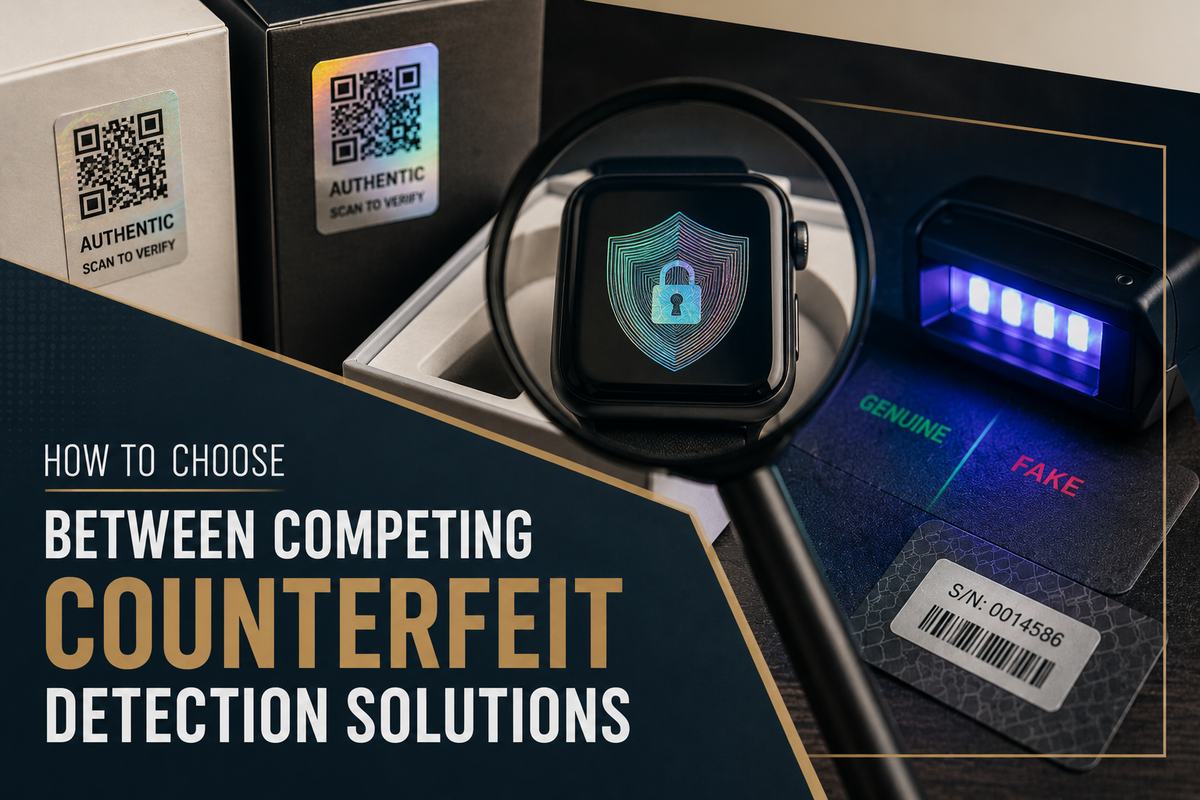
This guide covers the technologies that earn their keep, how to pressure test performance claims before you sign anything, what really drives cost, and how to compare vendors once you have a shortlist. The goal is a setup your staff will use during a busy shift, not a device that ends up in a drawer by the second month.
Key takeaways
- Start with your actual exposure, whether that is currency, identity documents, checks, or product authentication, because no single detector covers all four well.
- Layered verification beats any single test, since counterfeiters usually defeat one security feature at a time rather than all of them.
- Ask every vendor for a false positive rate alongside the detection rate, because false positives are what kill day-to-day adoption.
- Total cost includes consumables, template or software updates, integration, and training hours, not just the price of the unit.
- The best counterfeit detection solution is the one a busy employee can run in a few seconds without thinking about it.
What should a counterfeit detection solution actually do at your counter?
Before comparing brands, define what you are screening. Most businesses face four separate problems, and they call for different tools. Cash acceptance means verifying banknotes at speed. Identity verification means confirming that a driver’s license, passport, or military ID was issued by a real authority and belongs to the person holding it. Financial instruments mean checks, money orders, and cashier’s checks, which carry their own security features. Product authentication means confirming that a label, hologram, or serial number came from the real manufacturer.
A device that excels at one of these is often mediocre at the rest. In practice, the businesses that get burned are the ones that bought a currency detector and assumed it covered fake IDs, or bought an ID scanner and assumed a clean barcode read proved the document was genuine. Write down your top two exposures by dollar risk, then shop for those two. Everything else is a secondary consideration, and treating it as one keeps the decision simple.
Which counterfeit detection technologies actually matter, and how do they differ?
Counterfeit detection technology falls into a handful of families, and each one tests a different physical property. Ultraviolet light reveals fluorescent features and the embedded security thread in U.S. currency, which glows a distinct color depending on the denomination, as documented by the U.S. Currency Education Program at uscurrency.gov. Magnetic sensors read the magnetic properties of genuine banknote ink. Infrared imaging picks up ink patterns the eye cannot see. White light transmission shows watermarks and thread placement. Barcode and template-based ID readers parse the PDF417 barcode on North American driver’s licenses, which follows the AAMVA DL/ID Card Design Standard, and compare that encoded data against the printed front of the card.
No single test is decisive on its own. Counterfeiters generally defeat one feature at a time, so a layered check across two or three physical properties is far harder to beat than any single scan, and it is usually cheaper than buying a more sophisticated single sensor device.
| Technology | What it checks | Best suited for | Main limitation |
| Ultraviolet (UV) verification | Fluorescent inks, security threads, paper brighteners | Currency, IDs, checks, gift cards | Needs a trained eye and some control over ambient light |
| Magnetic ink sensing | Magnetic properties of genuine banknote ink | High volume cash acceptance | Currency focused, little value for identity documents |
| Infrared imaging | Ink patterns that absorb or pass infrared light | Currency and some secure documents | Usually bundled into higher cost automated devices |
| White light and magnification | Watermarks, microprinting, laminate tampering | IDs, passports, checks | Slower and dependent on manual inspection |
| Barcode parsing and templates | Encoded ID data versus the printed front of the card | Age-restricted sales, account opening, rentals | A well-made fake can encode matching data, so a second check is needed |
| Document forensics and AI review | Layout, fonts, and image artifacts against reference templates | Remote onboarding and high volume review | Depends on the reference library and the quality of the captured image |
For counter-level screening, most buyers land on UV plus one other property, because that pairing catches the majority of casual attempts without slowing the line. Some vendors, including Fraud Fighter, focus on UV-based counter units and ID authentication tools designed for frontline staff rather than back office analysts. Whichever brand you pick, the practical test is the same: can an employee finish the check in a few seconds without stopping the transaction?
How do you check performance claims before you buy?
Performance claims in this category are easy to make and hard to audit. A vendor quoting a detection rate should be able to answer three questions: what was tested, who tested it, and against what sample set. A near-perfect detection rate against a stack of low-quality inkjet fakes tells you almost nothing about performance against a bleached and reprinted note or a high-quality overlay ID.
Ask for the false positive rate next to the detection rate. A device that flags one genuine document in twenty gets switched off within a month, because staff learns to distrust it. What buyers tell us after the fact is that the false positive number mattered more to adoption than the headline accuracy figure ever did.
Then run a pilot. Two weeks on one register, with your real customer mix and your real lighting, will teach you more than any spec sheet. Ask for two reference customers at a similar size and transaction volume, and actually call them. Independent evaluation programs exist for some identity and biometric technologies, including the ongoing testing run by NIST, so ask whether the product or its underlying algorithm has been submitted, and ask to see the results rather than accepting a summary figure.
What are the most common myths about counterfeit detection technology?
Several beliefs about counterfeit detection survive because they were true a decade ago, or because nobody tested them. Clearing them up usually changes what a buyer shortlists, and it almost always changes how the tool gets used once it is installed.
| Common belief | What holds up in practice |
| A detection pen is enough | The pen reacts to starch in wood-based paper. Genuine U.S. notes use a cotton and linen blend, so they do not react. A real low-denomination note that has been bleached and reprinted as a higher one still passes, because the paper is genuine. |
| Cash is disappearing, so currency screening no longer matters | Cash mix varies sharply by industry and region, and per note exposure does not fall just because the average shopper taps a card. |
| If the barcode scans, the ID is real. | The PDF417 barcode holds encoded data, not proof of issuance. A well-made fake can carry a barcode that matches its own printed front, which is why a physical feature check still matters. |
| Automated review catches everything. | Document classification depends on its reference library and on image quality. It reduces manual work but does not remove the need for a human escalation path. |
| The most expensive device detects the most. | Price mostly tracks throughput, automation, and build quality. A mid-range unit used consistently outperforms a premium unit nobody switches on. |
When does it make sense to upgrade your counterfeit detection setup?
When it makes sense
Upgrading makes sense when one of four things is true. You took a loss and could not explain how the document got through. Your volume grew to the point where manual inspection slows the line. Your document mix changed, for example, you started accepting out-of-state IDs, mobile driver’s licenses, or larger cash transactions. Or your current equipment no longer reflects current document designs, which happens after a currency series update or a state license redesign. Choose to upgrade now if any of those apply. Choose to wait when your losses are near zero, your volume is stable, and your staff still complete checks consistently.
How to compare your options
Compare on five axes rather than feature counts: which physical properties the device tests, how many seconds a check adds per transaction, how much training a new hire needs, what it costs to keep current over three years, and what happens when a document gets flagged. Score each shortlisted option on all five, and the winner is usually obvious. Choose the faster device when queue time is your bottleneck. Choose the more thorough device when exposure per transaction is high, for example in check cashing, precious metals, orhigh-valuee retail, where one missed document outweighs a slower line.
What results to expect
Expect fewer completed attempts, not zero attempts. Screening moves the problem more than it ends it, because a determined counterfeiter simply walks to a business that does not check. Expect a short adjustment period where flagged genuine documents create friction, then a steady state. Useful outcome measures include monthly losses, attempts detected, average seconds added per transaction, and the share of eligible transactions actually screened. Set a baseline before rollout, because without one you cannot show whether the spend worked.
How much should you expect to spend on a counterfeit detection solution?
Pricing in this category spans a wide range, and list prices move often, so treat any figure in a comparison article as a starting point to confirm directly with the vendor. What stays stable is the shape of the cost: hardware, consumables, software or subscription, training, and staff time per check. Buyers who only compare unit prices tend to be surprised in year two.
| Category | What it typically includes | What drives the price up |
| Handheld UV lamp | A single UV source, portable, battery or plug-in | Build quality, bulb life, battery performance |
| Counter UV and white light station | UV, white light, magnification, sometimes infrared | Extra light sources, durability, footprint |
| ID scanner with template library | Barcode parsing, front and back comparison, logging | Template coverage, integrations, subscription tier |
| Automated currency discriminator | Multi-sensor counting and authentication in one pass | Notes per minute, sensor count, service plan |
| Identity verification software | Remote capture, liveness checks, document forensics | Volume tiers, liveness detection, compliance features |
Ask every vendor for a three-year total rather than a unit price. The line items that catch buyers off guard are replacement bulbs or sensors, annual template and software subscriptions, integration work with the point of sale system, and the labor hours for initial and refresher training. A cheap device with an expensive subscription can easily cost more over three years than a pricier unit with no recurring fee, so put both on the same spreadsheet before you decide.
How do you compare counterfeit detection vendors once you have a shortlist?
Once two or three options are on the table, the differences are rarely about the core sensor. They are about coverage, support, and how the product behaves on a bad day. Ask how often document templates and currency profiles are updated, who pays for those updates, what the support response time is, and what the escalation path looks like when an employee flags a document and the customer objects.
Choose the vendor with the broadest document library if you serve travelers, students, or a national customer base. Choose the vendor with the simplest workflow when turnover is high and training time is scarce. Choose the vendor with the strongest integration story when checks must be logged for compliance, and confirm exactly what the log retains, since storing scanned identity data carries its own legal exposure. RRetention rules differ by state and by industry, so confirm the specifics with counsel before you turn logging on.
| If your main exposure is | Prioritize | Choose this option when |
| Cash at the register | UV plus magnetic or infrared in a single fast pass | Speed matters more than depth, and note volume is high |
| Fake or borrowed IDs | Front and back cross-checking plus physical feature inspection | You handle age-restricted sales, account opening, or rentals |
| Checks and money orders | UV plus magnification and a payer verification step | You run check cashing, payroll services, or B2B receivables |
| High value goods | Layered verification plus a written escalation policy | One missed transaction outweighs the added friction |
| Remote or online onboarding | Document forensics with liveness detection | Customers never appear in person |
What should you expect from training, support, and document updates?
Detection technology fails for human reasons far more often than technical ones. What we see in practice is a device used correctly for the first few weeks, then a slow decline as staff turns over and nobody trains the replacements. Build the plan for that before you buy, not after the first loss.
Ask who delivers initial training, whether it is included, and how long it takes. Ask whether short refresher material exists that a shift lead can run in ten minutes. Ask how currency profiles and ID templates are updated, how often, and whether an update requires a service visit. Document designs do change: new currency series are issued periodically, states redesign licenses on their own schedules, and Body: “mobile driver’s licenses are being adopted state by state, which introduces a cryptographic verification flow that older hardware may not support.
How do you know your counterfeit detection solution is working after rollout?
Measure four things, and you will know inside a quarter. First, screening rate, meaning the share of eligible transactions where a check was actually completed, which you can sample by observation or pull from device logs. Second, detected attempts, meaning how many documents were flagged and what happened next. Third, losses, meaning chargebacks, write-offs, and cash shortages tied to accepted documents. Fourth, friction, meaning average seconds added per transaction and the number of customer complaints.
A healthy rollout shows a rising screening rate, a stable or falling loss figure, and a friction number that settles after the first month. If the screening rate drops below your target, the problem is almost always workflow or training rather than the device. Report these numbers monthly for the first quarter, then quarterly. Losses that stay flat while screening climbs usually mean the exposure sits somewhere else in the process, and that is worth finding before you buy more hardware.
Frequently Asked Questions
Is a counterfeit detection pen still worth using?
It works as a low-cost first screen and nothing more. The pen reacts to starch in ordinary paper, so it cannot flag a genuine note that was bleached and reprinted at a higher denomination. Pair it with a UV check, or replace it outright if your cash volume is meaningful.
Do I need separate devices for currency and identity documents?
Often yes, though not always. Currency verification and ID verification test different physical properties, and some counter stations combine UV, white light, and magnification well enough to cover both. If both risks are material to your business, look for a combined station or budget for two tools rather than hoping one stretches.
What should staff do when a document gets flagged?
Follow a written escalation policy: do not accuse anyone, bring in a supervisor, and document the transaction. In the United States, counterfeit currency investigations fall under the U.S. Secret Service, and suspected counterfeit notes are reported to them. Confirm the current reporting steps directly with the Secret Service.
How fast does a check need to be?
Fast enough that staff keep doing it. A few seconds per transaction is the practical ceiling in most retail settings. If a workflow adds much more than that, adoption falls off regardless of how good the detection rate looks on paper.
Do mobile driver’s licenses change what I need to buy?
They can. Mobile IDs built on ISO/IEC 18013-5 verify cryptographically rather than visually, so accepting one requires a reader or app instead of a light source.
Can AI review replace manual inspection?
Not entirely. Automated review lowers manual workload and keeps quality consistent at volume, but its accuracy depends on the reference library and the quality of the captured image. Keep a human escalation path for edge cases, and ask for evaluation results before trusting the automation with high-value decisions.
Where should you go from here?
Learn from other articles like this one before you commit to a purchase. A few more buyer-focused guides on verification technology, staff training, and loss prevention will sharpen the questions you bring into a vendor demo, and better questions produce better decisions than any spec sheet comparison ever will.
Read more like this, then go build your shortlist.