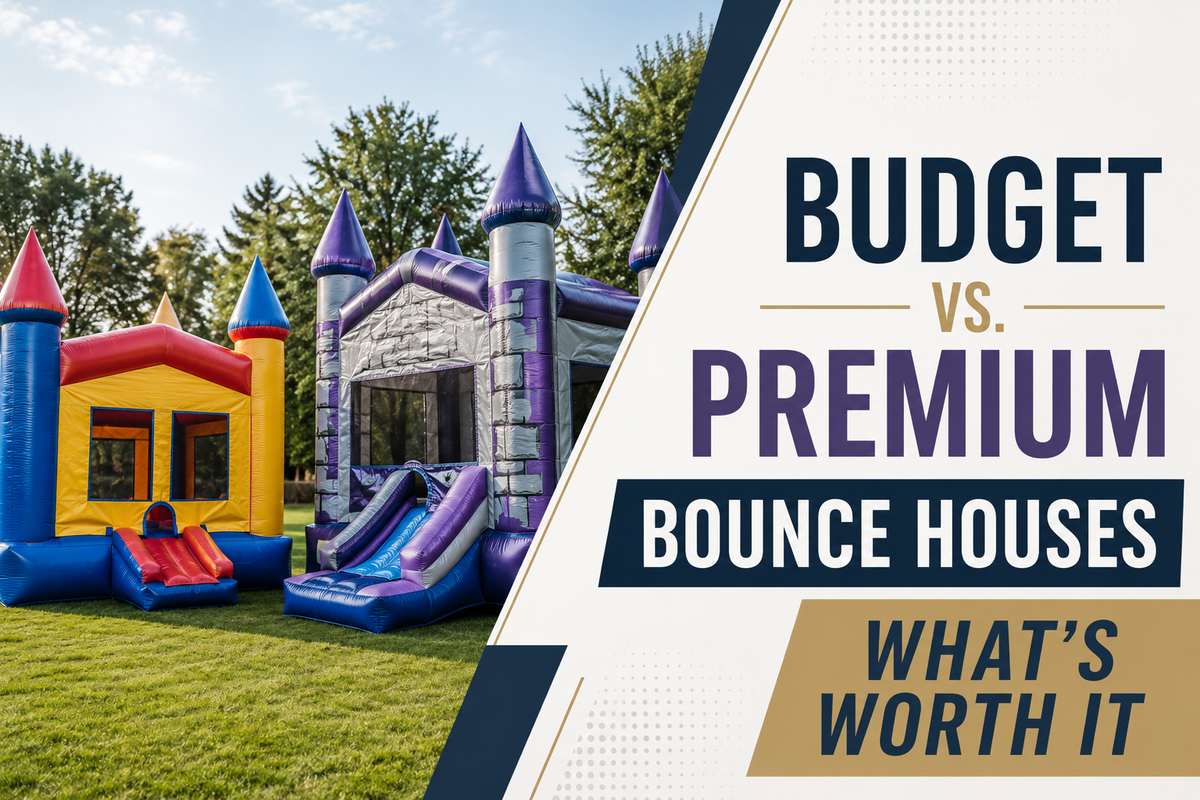
URL: budget-vs-premium-bounce-houses
Every inflatable shopper hits the same wall. A backyard bouncer and a rental-grade unit can be separated by an order of magnitude in price and still look nearly identical on a product page. The real budget vs. premium bounce houses question is not about price. It is about fabric weight, seam construction, blower quality, and how many hours the unit will actually run before it stops holding air.
This guide breaks down what you are paying for at each tier, where the extra money earns its keep, and where it does not. It is written for two very different buyers: the parent who wants a safe bouncer for birthday weekends, and the operator who needs equipment that survives repeated setups across a full season. The right answer is different for each, and it is not always the expensive one.
Key takeaways
- The difference between tiers is fabric weight and seam construction, not the artwork, the theme, or the dimensions printed on the box.
- Budget bouncers use lighter woven oxford or nylon fabric with stitched seams, which is fine for occasional family use and poor for repeated commercial use.
- Premium bouncers use PVC-coated vinyl with welded seams and reinforced stress points, and they carry warranties written around frequent use.
- Anyone renting a unit out for money needs commercial equipment; residential units fall outside the commercial standard and the warranty.
- CPSC incident reviews tie most inflatable injuries to improper operation, supervision, and setup, so buying premium does not substitute for anchoring and staffing the unit correctly.
What actually separates budget vs. premium bounce houses?
The gap between budget vs. premium bounce houses comes down to four measurable things: fabric weight, seam method, reinforcement at stress points, and the blower the unit is designed to run on. Budget bouncers are usually built from woven polyester sold as Oxford cloth, or from nylon, and joined with stitched seams. Premium bouncers are built from PVC-coated vinyl and joined with heat-welded seams that stitching alone cannot match, because welding fuses the coating into a continuous airtight bond.
Everything else is available at both tiers and tells you nothing. Theme, character artwork, footprint, a slide attachment, and even a stated weight capacity all appear on cheap and expensive units alike. When two listings show the same dimensions at wildly different prices, the spec sheet explains the gap, not the photos. If a seller will not publish fabric type, fabric weight, and seam method, treat that silence as an answer.
| Build element | Budget (residential) | Premium (commercial) |
| Fabric | Woven oxford or nylon, lighter weight | PVC-coated vinyl, substantially heavier and thicker |
| Seams | Stitched only | Heat welded, with stitching and reinforcement at stress points |
| Water handling | Absorbs water, slower to dry, mildew risk if stored damp | Non-porous surface, wipes down, dries faster |
| Blower | Small blower usually included | Dedicated commercial blower, often sold separately |
| Intended use | Occasional family use in a private yard | Repeated setups, rentals, schools, events |
| Standard referenced | Consumer product rules and ASTM F2729 for home use devices | ASTM F2374 for commercial use inflatable amusement devices |
Which materials matter most when you compare bounce houses?
Material is the single biggest driver of lifespan in a bounce house. Commercial PVC vinyl is a polyester scrim coated in vinyl, which creates a waterproof, non-porous surface that resists mold and mildew and can be heat welded into airtight seams. Oxford and nylon are woven textiles. They are lighter and easier to carry, but they take on water; they are joined with needle and thread, and every needle hole is a small, permanent air leak. That is why a lighter unit often needs its blower running harder to stay firm.
Commercial vinyl is sold by weight per square yard and residential oxford by denier, so the two are not directly comparable on paper, which is why sellers who publish neither are telling you something. Practical shortcut for buyers: weight is the tell. Two units of the same footprint should not differ substantially in packed weight unless the fabric is different. Suppliers that publish material specs on every listing make this comparison easy, and Hero Kiddo’s commercial inflatables are one example of a catalog built around a stated rental-grade vinyl rather than a generic fabric claim.
| Material | Where it wins | Where it falls short | Best fit |
| PVC-coated vinyl | Tear and abrasion resistance, welded airtight seams, easy to disinfect, handles wet and dry use | Heavier to move, higher purchase price, needs proper drying before storage | Rentals, schools, churches, heavy backyard use |
| Nylon | Stronger than most Oxford at the same denier, light to carry | Absorbs water, hard to confirm it is fully dry, stitched seams leak air | Occasional home use |
| Polyester oxford | Lightest option, cheapest, resists sagging, easy one-person setup | Thin, tears are often not repairable, short service life under heavy use | Toddler units and light backyard use |
How do seams, stitching, and anchor points change how long a bounce house lasts?
Bounce houses rarely fail in the middle of a panel. They fail at the joins. Seams, corner reinforcements, netting attachment points, and anchor rings absorb the load every time a group of kids lands in the same spot, and those are the places to inspect before you buy. On a premium unit, you should see multiple rows of stitching at high-stress areas, webbing sewn through the seam rather than tacked to the surface, and anchor rings that are stitched into a reinforced band, not riveted to a single layer of fabric.
Anchor points deserve more attention than most buyers give them. Count them, and count the stakes or sandbags in the box. A unit with too few tie-down points cannot be secured properly no matter how good the fabric is, and inadequate anchoring is one of the failure modes regulators keep pointing to. On the budget side, the compromise is usually visible: fewer anchor rings, single row stitching, and mesh walls sewn to the surface rather than sandwiched into a seam. That build is acceptable for a quiet backyard afternoon, and it is not acceptable for a public event.
Does the blower matter as much as the bounce house itself?
Most inflatables are continuous air devices, which means the blower is not an accessory; it is part of the structure. ASTM F2374 defines continuous air inflatable amusement devices as those that require air to be constantly supplied to maintain their structure and shape. If the blower stops, trips a breaker, or overheats, the walls come down while children are inside. Buyers comparing budget and premium bounce houses often price the inflatable alone and forget that a premium unit frequently ships without a blower, which narrows the price gap once you add one.
Three things to check on any blower, at either tier: the horsepower rating the manufacturer specifies for that exact unit, the amp draw against the circuit you plan to use, and the maximum extension cord length the manufacturer allows. Undersized cords are a common cause of underinflated units and tripped breakers. A soft, saggy bounce house is not just less fun; it changes how kids land. If a listing does not state which blower it requires, ask before you buy
How much should you expect to spend on a budget vs. a premium bounce house?
Prices in this category cluster into three bands, and the bands are set by material and construction rather than by brand prestige. Residential units sit at the low end, entry-level commercial units sit in the middle, and larger commercial combos with slides, obstacle lanes, or water features sit at the top. The important number is not the sticker price. It is cost per use. A cheap unit that fails in one season can cost more per party than a commercial unit that runs for years.
For rental operators, the math changes again, because the unit is a revenue asset rather than an expense. Payback depends entirely on local rental rates and booking volume, which vary by market, so treat any published payback timeline as a starting assumption to test against your own numbers rather than a promise.
| Tier | What you are paying for |
| Residential / budget | Light fabric, stitched seams, included small blower, easy solo setup |
| Entry level commercial | Commercial vinyl, welded seams, reinforced anchors, standards compliance |
| Large commercial combo | Bigger footprint, slide or water features, higher capacity, often two blowers |
Budget line items buyers forget: a second blower for larger units, longer rated extension cords, a patch kit, ground stakes or sandbags for hard surfaces, a tarp for the footprint, and a storage bag or bin that keeps the unit dry. These are small numbers individually, and they add up, especially on the budget tier where fewer of them are included in the box.
When does a budget bounce house make sense?
A budget bounce house is the right call more often than the internet admits. If the unit will be used a handful of times a year by a small number of children, in a private yard, on grass, with an adult present, the extra durability of commercial vinyl is capacity you will never draw on. Lighter units also solve a real problem: one adult can carry, set up, and store them without help, and that convenience is often what determines whether the thing gets used at all.
Choose a budget bounce house if you are buying for your own children, you expect occasional use, you have somewhere dry to store it, and nobody is paying to use it. Choose a budget bounce house if storage space or lifting capacity is the binding constraint, since a commercial unit can weigh several hundred pounds packed. Choose a budget bounce house if you are still testing whether your family will use one at all, and treat it as a trial rather than a long-term purchase.
When is a premium bounce house worth the extra money?
A premium bounce house earns the price difference when the unit will be set up and torn down repeatedly, used by mixed age groups including teens or adults, exposed to sun and water, or operated anywhere other people’s children are involved. Repeated setup cycles are what kill light fabric. Each fold, drag, and inflation cycle stresses the seams, and stitched seams in woven fabric give up long before welded vinyl does.
Choose a premium bounce house when the unit will generate revenue, because residential equipment used commercially typically falls outside the manufacturer warranty and outside the scope of ASTM F2374, which covers commercial-use devices and excludes inflatables marketed for private home use. Choose a premium unit when a venue, school, park, or insurer asks for documentation, since commercial suppliers can produce it and consumer sellers usually cannot. Choose a premium unit when you want wet and dry use from the same purchase, since vinyl handles water and drying far better than woven fabric.
How do you compare your options before you buy?
When it makes sense to move up a tier
Moving from a budget to a premium bounce house makes sense at the point where use frequency, user mix, or liability changes. The practical trigger points are these: frequent setups rather than a handful a year, users above the residential weight limits, any use on public or rented property, any use where you charge money, and any use where the unit stays out overnight or lives outdoors for a weekend. Below those thresholds, the premium spend buys durability you will not consume. Above them, the budget unit becomes the more expensive choice because you will replace it.
How to compare your options
Compare bounce house models on the four specs that actually vary, in this order. First, fabric type and weight, stated in oz per square yard for vinyl or denier for woven fabric. Second, seam method, welded or stitched, and how many rows of stitching sit at the stress points. Third, anchor points: how many, how they are attached, and what anchoring hardware ships with the unit. Fourth, blower requirement and whether it is included. Then read the warranty for what it excludes, because exclusions describe the use case the maker actually expects. Two units with the same footprint and price can differ on every one of these.
What results to expect
A budget bounce house used a few times a year, dried before storage, and kept out of direct sun should serve a family for several seasons, with slow air loss through stitched seams as the normal aging pattern. A premium bounce house under the same light use will outlast the child’s interest in it. Under heavy use, expect the opposite picture: budget fabric shows seam separation and stretched anchor points quickly, while vinyl shows scuffing and needs patch repairs at high-traffic spots but keeps holding air.
What safety standards should you check at either price point?
Two ASTM documents matter here, and they are not interchangeable. ASTM F2374, Standard Practice for Design, Manufacture, Operation, and Maintenance of Inflatable Amusement Devices, sets criteria for commercial-use inflatables used in rental fleets, parks, schools, carnivals, and events, and it explicitly excludes inflatable devices marketed directly to consumers for private home use by children. ASTM F2729 is the consumer safety specification covering constant air inflatable play devices for home use. If a seller cites the commercial standard on a unit that is plainly residential, that is a flag worth asking about.
The injury data points somewhere buyers rarely look. In its 2015 safety bulletin on inflatable amusements, the U.S. Consumer Product Safety Commission noted that the incidents its staff reviewed were attributable primarily to improper operation, supervision, and setup. The takeaway for this comparison is blunt: paying more does not buy safety. Anchoring, supervision, weather limits, and age separation do.
Also ask about NFPA 701 flame propagation testing on the fabric, which commercial suppliers commonly reference, and read the manufacturer’s stated wind limit. Wind ratings are the single most ignored line in the manual, and they apply at every price point.
What do buyers most often get wrong when comparing budget and premium bounce houses?
The pattern we see in practice is that buyers over-research the theme and under-research the spec sheet. These are the five mistakes that cost people the most money.
- Buying on footprint alone. Two units with identical dimensions can sit three or four times apart in price and not be the same product. The dimensions match, and the fabric does not.
- Assuming a stated weight capacity means the unit was built for adults. Capacity is a number on a listing. Fabric weight, seam method, and anchor count are what actually hold it.
- Buying residential to rent out. This usually voids the warranty, sits outside the commercial standard, and creates an insurance conversation you do not want to have after an incident.
- Forgetting the blower and the accessories. A premium unit that ships without a blower is not as far from a budget unit as the sticker price suggests once you add one.
- Storing the unit damp. This is the fastest way to ruin either tier, and it hits woven fabric hardest because it holds water in the weave where you cannot see it.
What does ownership actually look like after the purchase?
Ownership cost is where the two tiers separate again. Budget bouncers ask for less storage space and less handling equipment, but they ask for more caution: dry them completely, keep them off abrasive surfaces, and accept that a significant tear often ends the unit because woven fabric is difficult to repair invisibly. Premium vinyl units ask for more muscle and more storage, and they give back repairability. A vinyl patch, properly applied, restores a panel and the unit goes back into service.
Build a simple maintenance rhythm at either tier: sweep and wipe the deck after every use, inspect seams and anchor points before every setup, log any repair with a date, and dry the unit fully before it goes into storage. Operators renting units out should keep that log in writing, because inspection records are the kind of documentation venues and insurers ask for.
Frequently asked questions
Is a commercial bounce house safe to use in a backyard?
Yes. Commercial grade units are heavier and built for repeated use, and there is nothing about that construction that makes them unsuitable for home use. The practical limits are space, storage, and handling, since commercial units are significantly heavier to move and require the manufacturer’s specified blower and anchoring.
Can I use a residential bounce house for a rental business?
It is not advisable. ASTM F2374 covers commercial use inflatable amusement devices and specifically excludes inflatables marketed to consumers for private home use, and using residential equipment commercially generally falls outside the manufacturer’s warranty. Venues and insurers frequently ask for documentation that residential equipment cannot provide.
How can I tell if a bounce house is really commercial grade?
Check the spec sheet, not the description. Commercial units publish fabric type and weight, usually PVC vinyl in oz per square yard, describe welded seams and reinforcement at stress points, list anchor point counts, and specify a required blower. If a listing avoids all four of those specs, treat it as residential regardless of the wording.
Does a more expensive bounce house mean fewer injuries?
Not by itself. CPSC staff reviewing inflatable amusement incidents attributed them primarily to improper operation, supervision, and setup. Correct anchoring, age and size separation, a supervising adult, and respecting the manufacturer’s wind limits do more for safety than the price tier does.
How long does a bounce house last?
It depends almost entirely on use frequency, drying, and storage rather than on the badge. Light home use with proper drying can carry either tier for years, while frequent setups and teardowns wear stitched woven seams far faster than welded vinyl.
Is it cheaper to buy or to rent?
For one or two events a year, renting is usually cheaper once you count storage, cleaning, drying, and the blower. Buying starts to win when you host frequently, when you want the unit available on short notice, or when the unit will generate rental income of its own.
Keep reading before you buy
The short version: match the tier to the use, not to the budget. If the unit will be used occasionally by your own family, a budget bouncer that is easy to carry and easy to store is a sound purchase. If the unit will be set up repeatedly, used by bigger kids, exposed to water, or rented to anyone, commercial vinyl is the cheaper choice over any horizon longer than a season.
Read more like this. Our other buyer guides cover blower sizing, anchoring on hard surfaces, wet and dry unit selection, and how to inspect an inflatable before every setup.