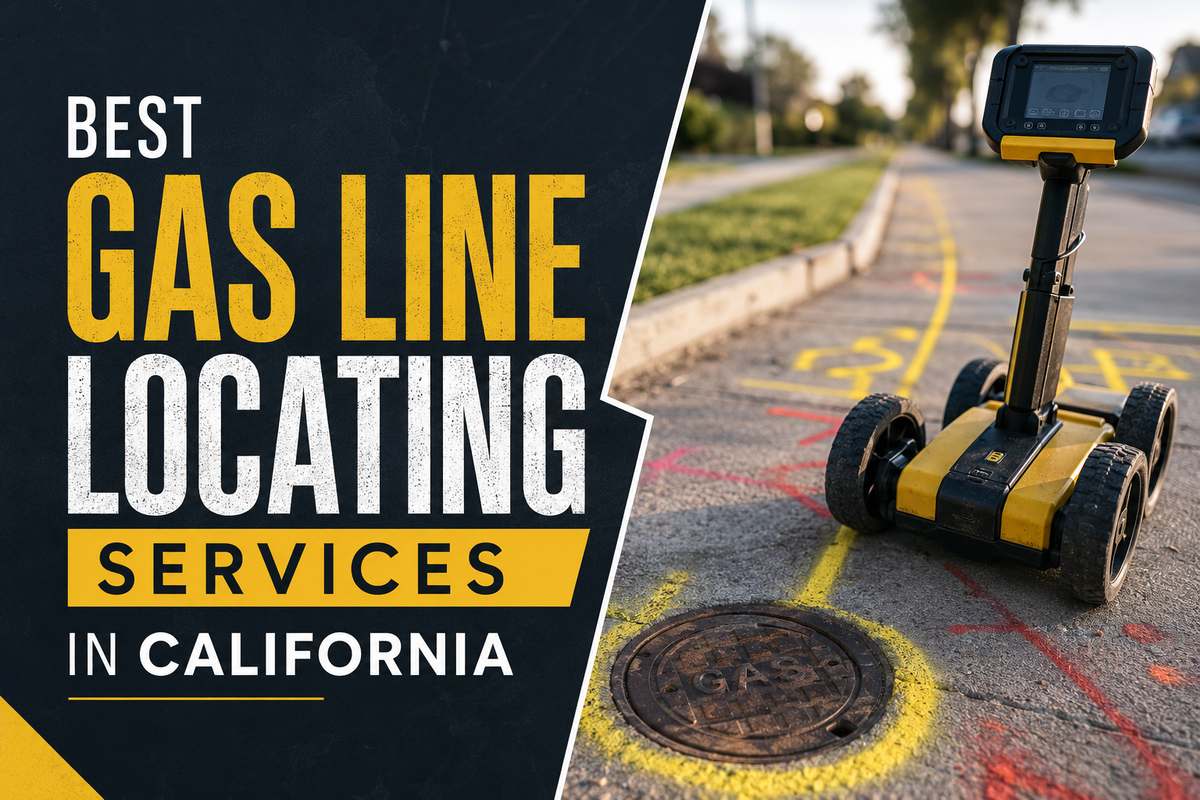
When excavation work goes wrong, the consequences can be catastrophic. In California, where underground utility networks are dense and aging infrastructure complicates subsurface work, professional gas line locating isn’t just a best practice; it’s a regulatory requirement and a safety imperative. This guide evaluates nine of California’s most capable gas line locating services based on technological capabilities, service coverage, response times, and real-world performance data to help contractors, municipalities, and engineering firms make informed decisions.
Quick Comparison Table
| Company | Best For | Service Area | Rating | Pricing |
| Coastline Utility | Fast Bay Area response | Northern CA/Bay Area | 5.0 stars (Google) | Custom quote |
| GPRS | Enterprise-scale projects | Statewide/National | 4.2/5 (Google) | $800-$1,500/day (est.) |
| Blood Hound Underground Utility Locators | 24-hour emergency response | Statewide/National | 3.3/5 stars (Google) | Custom quotes |
| BESS Utility Solutions | Combined locating + excavation | Northern & Central CA | 5.0 stars (Google) | Custom quote |
| Util-Locate | Southern California specialists | Southern CA/Arizona | 4.3 stars (Yelp) | Custom quote |
| Specialized Testing | Structural/materials projects | LA/Orange/San Bernardino/Riverside | 5 star (Google) | Custom quote |
| SoCal Locators | Minority-owned business preference | Southern CA/Inland Empire | 5 star (Google) | Custom quote |
Coastline Utility Services
Location: Morro Bay, CA
Service Area: Northern California and San Francisco Bay Area
Phone: 669-371-0822
Rating: 5.0 stars (Google)
Pricing: Custom quotes available
Website: https://coastlineutility.com/
Founded in 2023, Coastline Utility Services has quickly established itself as a responsive choice for Bay Area contractors who value direct communication over call-center bureaucracy. Their focus on Northern California allows them to maintain consistently fast turnaround times, typically scheduling jobs within one to three business days.
Key Services:
- Underground utility locating (gas, water, electric, telecom)
- Ground Penetrating Radar (GPR)
- Non-destructive potholing
- CCTV drain inspection and leak detection
Pros:
- Direct access to decision-makers rather than tiered customer service
- Fast scheduling for time-sensitive Bay Area projects
- Deep expertise in California dig laws and regulatory compliance
Cons:
- Service area strictly limited to Northern California, unsuitable for statewide or Southern California work
The company maintains perfect 5-star ratings on multiple platforms, though their Yelp profile currently lacks sufficient reviews for a published rating. For contractors working exclusively in the Bay Area market who prioritize responsive service, Coastline offers a strong regional alternative to national chains.
GPRS (Ground Penetrating Radar Systems)
Location: 1901 Indian Wood Cir, Maumee, OH 43537 (Headquarters); extensive California operations
Service Area: Nationwide, including comprehensive California coverage
Phone: 818-938-1829
Rating: 4.2/5 (Google)
Pricing: Custom quotes
Website: https://www.gp-radar.com/
With 25 years of operation and over 500 SIM-certified Project Managers nationwide, GPRS represents the largest scale option for gas line locating in California. Their proprietary SiteMap® platform transforms traditional utility locating into comprehensive infrastructure data management, delivering georeferenced 3D digital twins of underground networks.
Key Services:
- Private utility locating and mapping
- Concrete scanning and imaging
- 3D laser scanning and reality capture
- CCTV video pipe inspection
- Leak detection
Pros:
- SiteMap® platform provides unmatched documentation and infrastructure visualization
- “Green Box Guarantee” backs their accuracy claims
- Massive resource capacity for multi-site or urgent projects
Cons:
- Corporate pricing structure and minimum site fees may significantly exceed local competitors for smaller residential or single-line jobs
- National scale can mean less personalized service than regional specialists
GPRS has completed high-profile projects for major universities and commercial facilities. Their technological sophistication makes them particularly valuable for clients who need comprehensive subsurface documentation beyond basic line marking. However, contractors on tighter budgets or handling smaller jobs may find their pricing prohibitive.
Blood Hound Underground Utility Locators
Location: 6500 Technology Center Drive, Suite 200, Indianapolis, IN 46278
Service Area: Nationwide, including strong California presence
Phone: 888-480-3804
Rating: 3.3/5 stars (Google)
Pricing: Custom quotes available
Website: https://www.bhug.com/
Founded as a specialized private locating firm, Blood Hound operates as part of the USIC family of companies while maintaining a distinct focus on private utility work that falls outside 811’s scope. Their technicians average five years of experience, and the company guarantees 24-hour emergency response times.
Key Services:
- Private utility locating (lines not covered by 811)
- Ground penetrating radar (GPR)
- CCTV robotic camera sewer inspections
- Vacuum excavation
Pros:
- Guaranteed 24-hour response time for emergency private locating needs
- Technician experience requirements exceed industry averages
- Greater than 99% claimed accuracy rate
Cons:
- California operations managed as subsidiary of massive corporate structure, potentially lacking local personalization
- Inherits some workforce management challenges common to USIC-affiliated companies
Blood Hound has earned trust from complex clients including military installations like Naval Air Station Jacksonville. Their emergency response guarantee makes them particularly valuable for urgent situations where delays could shut down active construction sites. However, contractors seeking the personal touch of California-native firms may find their corporate structure less appealing.
BESS Utility Solutions
Location: Hayward, CA (Headquarters); offices in Fresno, Orange, Sacramento, and Phoenix
Service Area: Northern and Central California, plus Arizona
Phone: (408) 988-0101
Rating: 5.0 stars (Google)
Pricing: Custom quotes available
Website: https://www.bessutilitysolutions.com/
With 31 years of operation, BESS Utility Solutions distinguishes itself by combining electronic utility locating with in-house hydro vacuum excavation capabilities. This vertical integration allows them to both electronically locate lines and physically verify depths through potholing, all within a single service call.
Key Services:
- Ground Penetrating Radar (GPR) and utility mapping
- Hydro vacuum excavation (potholing)
- Concrete scanning and cutting
- CCTV pipeline inspection
Pros:
- Single-source solution for both locating and physical verification streamlines pre-construction processes
- Strict adherence to ASCE 38-02 standards for utility locating
- Claims over 1,000 satisfied clients across California
Cons:
- Yelp profile is currently unclaimed, with limited verifiable third-party reviews beyond website testimonials
BESS’s integrated approach particularly benefits contractors working on complex projects where physical potholing is required to confirm line depths before excavation. However, the discrepancy between their claimed 150+ five-star reviews and their unclaimed, sparsely reviewed Yelp profile warrants additional verification of their reputation claims.
Util-Locate
Location: Fullerton, CA
Service Area: Southern California (Los Angeles, San Diego, Orange, Riverside, San Bernardino) and Arizona
Phone: (855) 979-9439
Rating: 4.3/5 stars (Yelp)
Pricing: Custom quotes available
Website: https://www.util-locate.com/
Founded in 2001, Util-Locate has spent 25 years developing specialized expertise in Southern California’s complex utility infrastructure. Performing over 11,000 locates annually, they’ve built a reputation as budget-conscious specialists who understand the region’s unique subsurface challenges.
Key Services:
- Underground private utility locating
- Potholing and vacuum excavation
- Utility mapping
- CCTV inspection
Pros:
- Deep regional specialization in Southern California utility networks
- Reviewers consistently praise their ability to handle difficult private locates cost-effectively
- Long-term partnerships with telecommunications infrastructure companies
Cons:
- Some negative feedback cites slow response times to initial inquiries during peak periods
- Limited geographic scope excludes Northern California projects
Util-Locate’s quarter-century focus on Southern California has given them institutional knowledge of the region’s utility layouts that newer or geographically broader competitors can’t match. For contractors working exclusively south of the Tehachapis, their regional expertise and competitive pricing make them a strong consideration, though patience may be required during proposal phases.
Specialized Testing
Location: 10600 Pioneer Boulevard, Suite H Santa Fe Springs, California 90670
Service Area: Los Angeles, Orange, San Bernardino, and Riverside counties
Phone: (562) 573-9811
Rating: 5/5 Google (low review volume)
Pricing: Custom quotes available
Website: https://specializedutilitylocating.com/
Founded in 1989, Specialized Testing operates primarily as an ISO/IEC 17025:2017-accredited materials testing laboratory that also maintains a utility locating and concrete scanning division. This unique positioning allows them to scan concrete for utilities, perform core drilling, and test the extracted materials all under one roof.
Key Services:
- GPR utility scanning and private locating
- Concrete scanning and coring
- Materials and concrete testing (ASTM/ICC standards)
- CCTV video pipe inspection
Pros:
- Exceptional for structural projects requiring integrated utility locating, concrete coring, and materials testing
- Approved testing facility by the American Concrete Institute (ACI) and City of Los Angeles
- 30+ years of laboratory and testing expertise
Cons:
- Utility locating operates as a sub-division of a larger materials testing focus, potentially lacking the singular attention of dedicated locating firms
- Limited online reviews specific to utility locating services
For contractors managing complex structural projects where concrete scanning, core drilling, and materials testing all converge, Specialized Testing’s integrated capabilities eliminate the coordination overhead of managing multiple specialized vendors. However, contractors seeking dedicated utility locating services may find better-focused alternatives elsewhere.
SoCal Locators
Location: Fontana, CA
Service Area: Southern California and Inland Empire
Phone: (909) 900-6504
Rating: 5 star (Google) (low review volume)
Pricing: Custom quotes available
Website: https://www.socallocators.com/
SoCal Locators brings over 50 years of combined team experience to Southern California utility locating, with particular emphasis on their status as a certified minority-owned business enterprise. This certification makes them valuable for projects requiring minority-owned business participation.
Key Services:
- Conductive utility line locating (gas, electric)
- Water and sewer line locating
- Telecommunication line locating
- Area and storm drain pipe locating
Pros:
- Certified minority-owned business helps contractors meet supplier diversity requirements
- Deep community roots in Fontana and Inland Empire
- Emphasis on ethical business practices
Cons:
- Limited digital footprint with unclaimed Yelp profile and no verifiable third-party reviews
- Smaller online presence compared to larger regional competitors
For commercial contractors and municipalities with supplier diversity initiatives or minority business inclusion goals, SoCal Locators offers both technical capabilities and the MBE certification that can fulfill contract requirements. However, the absence of verifiable third-party reviews means contractors should request references and conduct additional due diligence before engaging.
Choosing the Right California Gas Line Locating Provider
California’s gas line locating market offers solutions ranging from nimble regional specialists to enterprise-scale national providers. Coastline Utility Services and Util-Locate excel for contractors seeking responsive, region-focused service in Northern and Southern California respectively. GPRS brings unmatched resources for large, multi-site projects despite higher costs and some workforce management concerns. Blood Hound’s 24-hour guarantee suits emergency situations, while BESS Utility Solutions’ integrated excavation capabilities streamline complex projects.
For contractors managing structural work requiring integrated testing, Specialized Testing’s laboratory capabilities provide unique value. SoCal Locators offers MBE certification for diversity-focused contracts, though their limited online presence warrants additional reference checking. Ultimately, the best choice depends on your project’s geographic scope, timeline urgency, technological requirements, and budget parameters.
Before any excavation project, remember that California law requires contacting 811 at least two business days before digging, and private utility locating should supplement, not replace, this legally mandated service.
Frequently Asked Questions
How much does gas line locating typically cost in California?
Professional gas line locating costs vary significantly based on project scope, site complexity, and technology required. Industry standards suggest $800 to $1,500 per day for professional GPR services, though simple residential single-line locates may cost $200 to $500. Emergency 24-hour services typically command premium pricing. Most providers offer custom quotes rather than published rate sheets, so obtaining multiple bids is advisable.
Is calling 811 enough, or do I need private utility locating services?
California’s 811 service (DigAlert) marks public utility lines owned by gas, electric, water, and telecom companies. However, 811 does not locate private utilities, including lines running from the street to your building, inter-building connections on campuses, abandoned services, irrigation systems, or private telecom/fiber installations. For comprehensive protection, most excavation projects require both 811 public marking and private utility locating services.
What’s the difference between electromagnetic locating and Ground Penetrating Radar?
Electromagnetic (EM) locating works by tracing electrical signals through metallic or conductive utility lines, making it highly effective for active gas, electric, and communication lines. Ground Penetrating Radar (GPR) uses radio waves to detect subsurface anomalies, allowing it to find non-conductive materials including PVC pipes, concrete conduits, voids, and abandoned lines that EM cannot detect. Most professional locators use both technologies in combination for comprehensive subsurface mapping.
How accurate are professional utility locates?
Professional utility locating companies typically claim 99% to 99.97% accuracy rates when proper protocols are followed. However, accuracy depends heavily on site conditions, utility depth, soil composition, interference from nearby power sources, and whether utilities are correctly mapped in existing records. Physical potholing (vacuum excavation) remains the only definitive verification method and is often required by California regulations before digging near critical infrastructure.
What certifications should I look for in a utility locating company?
Reputable locating companies should employ technicians with certifications from organizations including the Subsurface Utility Engineering Association (SUEA), National Utility Locating Contractors Association (NULCA), or similar industry bodies. Look for SIM (Subsurface Investigation Methodology) certification, adherence to ASCE 38-02 standards for subsurface utility engineering, and evidence of ongoing technician training. Additionally, verify the company carries adequate liability insurance given the consequences of locating errors.