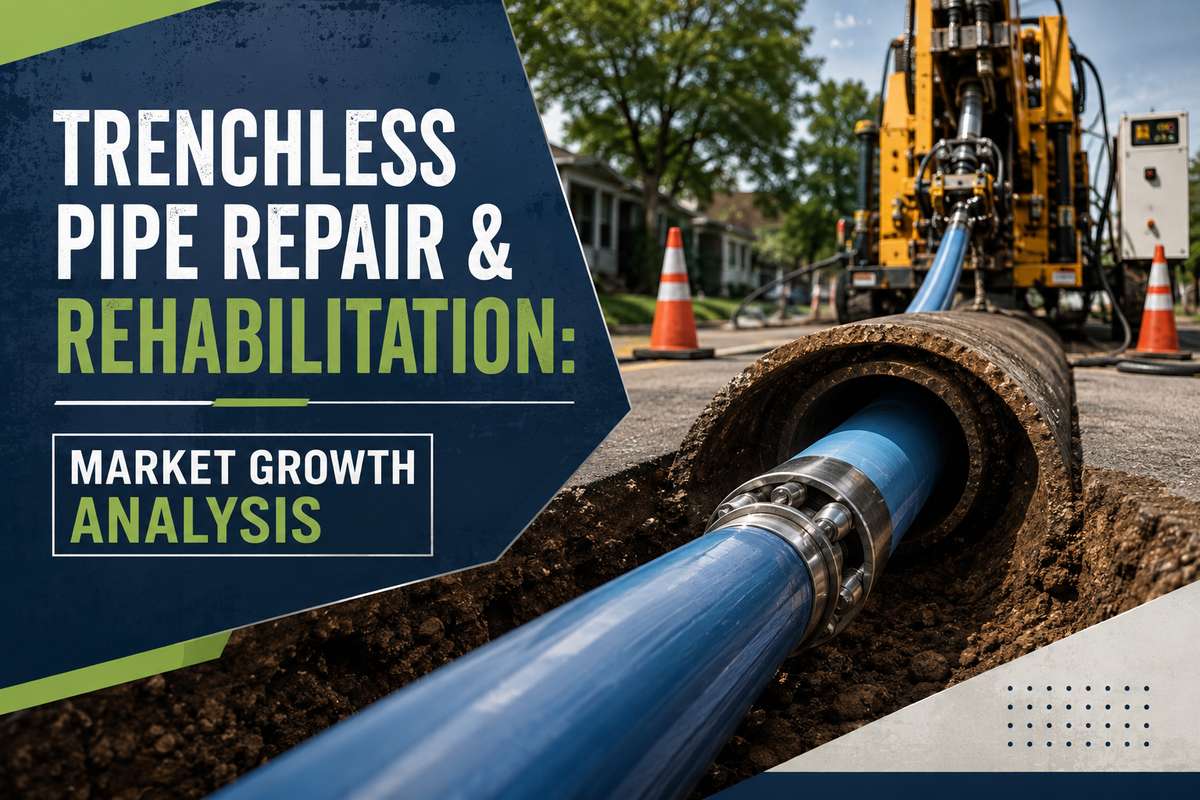
A forward-looking analysis of the trenchless pipe repair and rehabilitation sector: current market size, the outlook to 2031, the technologies and companies reshaping underground infrastructure renewal, and the regulatory and funding forces steering demand.
1. Executive Summary
1.1 Synthesis Overview
Trenchless pipe repair and rehabilitation, the family of methods that renews buried water, sewer, and gas pipelines without open excavation, has moved from a specialty technique to the default approach for municipal infrastructure renewal across North America. The sector sits at the intersection of three durable forces: an aging pipe network valued at nearly a trillion dollars, a federal regulatory mandate to replace lead service lines, and a public-works funding wave that peaked under the Bipartisan Infrastructure Law. Together, these push demand toward minimally disruptive renewal and away from dig-and-replace.
Market-sizing estimates diverge sharply because analysts scope the sector differently. Narrowly defined (rehabilitation services and lining), Fortune Business Insights valued the global trenchless pipe rehabilitation market at roughly $4.9 billion in 2025, while Stratview Research put the 2025 figure near $7.8 billion. Broader definitions run much higher: Market Research Future scopes the space at $22.7 billion in 2025. For the 2026 to 2031 window, most independent forecasts cluster in a 4.5% to 7.5% CAGR band, with pipe bursting and water-main rehabilitation growing fastest. This report treats the mid-single-digit range as the defensible base case.
Directional verdict: moderate-to-strong growth. The sector is not a breakout, high-multiple growth story; it is a steady, compounding, recession-resistant infrastructure market underpinned by non-discretionary replacement need. On the base case, the global market roughly grows from a 2026 value in the mid-single-digit billions to a materially larger 2031 figure, with North America retaining the largest regional share and Asia-Pacific growing fastest. The central risk is not demand, which is structural, but a 2026 to 2027 public-funding cliff as Infrastructure Investment and Jobs Act (IIJA) money is drawn down.
1.2 Key Findings at a Glance
- Structural demand. The U.S. Environmental Protection Agency (EPA) estimates the nation needs $625 billion in water infrastructure investment over 20 years, and the American Society of Civil Engineers (ASCE) graded drinking water at C-minus and wastewater at D-plus in its 2025 report card. That gap is the sector’s demand engine.
- Regulatory tailwind. The EPA’s 2024 Lead and Copper Rule Improvements (LCRI) require roughly 67,000 public water systems to replace lead service lines within a decade, converting a discretionary upgrade into a compliance obligation.
- Consolidation. Azuria Water Solutions (the former Aegion, private-equity owned by New Mountain Capital) has completed more than a dozen acquisitions since 2022, assembling a one-stop trenchless portfolio and setting the pace for roll-up activity.
- Technology shift. UV-cured CIPP, AI-assisted CCTV defect analysis, and robotic inspection and lateral repair are compressing cure times, improving targeting, and reducing the styrene-emission concerns that shadow traditional resin lining.
- Funding-cliff watch. IIJA water authorizations expire September 30, 2026; the Water Resources Development Act (WRDA) of 2026 and the State Revolving Funds are the bridge, but a proposed FY27 cut introduces real timing risk.
[IMAGE SUGGESTION: Summary infographic with four stat callouts, 2026 market-size range, base-case CAGR, EPA $625B 20-year need, and 9M+ lead service lines. Source: Sections 1 and 2.]
2. Present-Day Sector Overview
2a. Sector Definition & Scope
Trenchless pipe repair and rehabilitation covers the engineering methods used to inspect, repair, renew, or replace underground pipelines with little or no surface excavation. The core method families are: cured-in-place pipe (CIPP) lining, in which a resin-saturated liner is inserted into a host pipe and cured with heat, steam, hot water, or ultraviolet light to form a structural pipe-within-a-pipe; pipe bursting, which fractures the old pipe outward while pulling a new one through; sliplining and spray-in-place linings; horizontal directional drilling (HDD) for new installation; and point or lateral repairs. Upstream of the repair sits a diagnostic layer: CCTV drain inspection, ground penetrating radar (GPR), acoustic leak detection, and utility locating, which determine pipe condition and precise position before any work begins.
CIPP remains the dominant method, holding roughly 42% of trenchless rehabilitation activity by method type in 2025 per SNS Insider, because it renews pipe across a wide diameter range without excavation. Pipe bursting is the fastest-growing method as aging cast-iron and vitrified-clay sewers deteriorate past the point where lining alone restores adequate service life. Applications split across sanitary sewer, stormwater, potable water mains, and industrial and gas pipelines, with wastewater historically the largest application and water mains projected to overtake it as lead-line and non-revenue-water pressures mount.
2b. Current Market Size & Growth Rate
Published market-sizing figures vary widely by scope and should be read as a range rather than a single point. For the global trenchless pipe rehabilitation market: Fortune Business Insights valued it at $4.91 billion in 2025, growing to $5.19 billion in 2026; Stratview Research put the 2025 figure at $7.8 billion; and Market Research Future scoped it far higher at $22.7 billion in 2025 under a broader definition. Adjacent segments are sized more tightly: the CIPP sub-market alone was roughly $2.5 billion to $3.0 billion in 2025 (QY Research, Stratview), and North American trenchless rehabilitation was about $4.5 billion in 2025 per Stratview, with North America holding a 36% global share per Fortune Business Insights.
A reasonable mid-point read is that the global core rehabilitation market sits in the mid-single-digit billions (roughly $5 billion to $8 billion) entering 2026, with the broadest definitions that fold in equipment, HDD, and new installation reaching the low-$20-billion range. Recent year-over-year growth has run near 5% to 6%, ahead of general construction, reflecting the non-discretionary nature of pipe failure.
[IMAGE SUGGESTION: Column chart of global trenchless rehabilitation market size 2026 vs 2031 showing three source scenarios (Fortune Business Insights, Stratview, Market Research Future) as a range. Source: Section 2b and Section 4a.]
2c. Demand Drivers
- Aging infrastructure. The U.S. operates more than 2 million miles of underground water pipe across roughly 150,000 public water systems; many mains and sewers have passed their 40-to-50-year design life. ASCE reports combined-utility renewal rates hovering at just 1.1% to 2.0% annually, far below replacement need.
- The investment gap. ASCE’s 2024 economic study puts the annual water-infrastructure investment gap at $99 billion, up from $81 billion in 2021, and the EPA pegs 20-year needs at $625 billion. Trenchless methods stretch constrained budgets because they cost less and disrupt less than open-cut replacement.
- Lead service line mandate. More than 9 million lead service lines remain in service; the LCRI compels their replacement, a direct, dated demand signal for both replacement and trenchless installation methods.
- Urban disruption avoidance. In dense and high-traffic corridors the indirect costs of open-cut work (road closures, business disruption, restoration) often exceed the pipe cost itself, tilting the total-cost calculation decisively toward trenchless.
- Non-revenue water and resilience. Utilities under pressure to cut water losses and harden systems against drought, flooding, and wildfire increasingly favor proactive rehabilitation over reactive emergency repair.
2d. Current Challenges
The sector’s constraints are less about demand than about delivery. Skilled-labor shortages limit how fast contractors can scale crews. Project timelines are long: securing State Revolving Fund financing, permitting, and completing a wastewater project can take five to ten years, which throttles how quickly funding converts to installed pipe. Material and resin cost volatility pressures fixed-price municipal contracts. And the CIPP process carries an environmental and occupational-health question mark around styrene emissions that has drawn academic scrutiny and shaped best-practice guidance.
2e. Sector Headwinds
| Headwind | Description | Severity |
| Public-funding cliff | IIJA water authorizations expire Sept. 30, 2026; proposed FY27 cuts could sharply reduce State Revolving Fund flows before WRDA 2026 reauthorization is settled. | High |
| Skilled-labor shortage | Trained trenchless crews and certified inspectors are scarce, capping how fast contractors can absorb demand. | Medium |
| Styrene / VOC scrutiny | Styrene-based CIPP resin emissions are a documented worker and community-health concern; regulation is patchwork but tightening pressure exists. | Medium |
| Long project cycles | Multi-year permitting and financing lags delay revenue recognition and mask underlying demand. | Medium |
| Municipal budget sensitivity | Local-government fiscal stress and interest-rate exposure can defer non-emergency projects. | Medium |
| Method misapplication risk | Lining a pipe too far deteriorated for CIPP can force costly rework, a reputational and warranty risk. | Low |
3. Competitive Landscape
3a. Market Leaders
The rehabilitation market is fragmenting at the bottom and consolidating at the top. Thousands of regional contractors and diagnostic specialists serve local municipalities and property owners, while a small group of well-capitalized platforms, led by Azuria, roll up capabilities into national one-stop offerings. The table profiles representative leaders and fast-movers across the value chain.
| Company / HQ | Market Position | Core Offering | Competitive Moat | Recent Moves | Growth Trajectory |
| Azuria Water Solutions (formerly Aegion) / St. Louis, MO | Clear market leader in North American trenchless rehab | CIPP (Insituform), pipe bursting, lateral lining, corrosion protection, lead-line replacement | Scale, proprietary Insituform technology, PE backing (New Mountain Capital), broadest portfolio | Rebranded from Aegion in April 2024; 12+ acquisitions since 2022 including Waterline Renewal Technologies and BLD Services | Strong, acquisitive |
| Granite Construction / Watsonville, CA | Large diversified infrastructure contractor | Water and sewer rehabilitation within broad civil construction | National footprint, public-works relationships, balance-sheet scale | Continued water and pipeline project wins across the West | Steady |
| Inland Pipe Rehabilitation (IPR) / Atlanta, GA | Leading independent rehabilitation specialist | CIPP, spray-applied linings, manhole rehab | Specialist focus and municipal track record | Ongoing regional expansion and municipal contract wins | Growing |
| Michels Corporation / Brownsville, WI | Major utility and pipeline contractor | Trenchless installation, HDD, rehabilitation, energy pipelines | Heavy-civil and HDD capability, self-perform scale | Large-diameter and utility infrastructure projects nationwide | Steady |
| Per Aarsleff / Denmark (global) | Global pipe-rehabilitation leader | CIPP and trenchless renewal across Europe and beyond | International scale and long CIPP heritage | European water-directive-driven project pipeline | Steady growth |
| HammerHead Trenchless (Charles Machine Works/Toro) / Lake Mills, WI | Leading equipment and technology supplier | Pipe bursting, lining, and robotic rehab equipment | Equipment installed base and dealer network | Acquired ProKASRO Services USA assets (May 2025) to add robotic inspection and UV-curing | Expanding via M&A |
| SAK Construction / O’Fallon, MO | Large independent trenchless contractor | CIPP, sliplining, large-diameter rehab | Large-diameter and tunneling expertise | Ongoing municipal large-diameter awards | Steady |
3b. Emerging Challengers & Niche Players
Beyond the incumbents, several categories of challenger are reshaping the edges of the market. On the technology side, robotics and imaging specialists such as ProKASRO (now within HammerHead), Bwell Technology, and Wuhan Easy-Sight are pushing HD and AI-enabled inspection crawlers and UV-CIPP curing systems that raise diagnostic precision and shrink cure times. On the residential and lateral side, franchised and regional players (for example, NuFlow, Perma-Liner installers, and MaxLiner networks) serve the small-diameter service-lateral market that municipal contractors underserve. And a growing tier of regional diagnostic and utility-locating specialists occupies the essential pre-repair layer: CCTV inspection, GPR mapping, potholing, and leak detection that every trenchless project depends on. Coastline Utility Services sits in this diagnostic and site-intelligence tier in California.
3b.1 Company Spotlight: Coastline Utility Services
What they do. Coastline Utility Services is a female-owned, family-run utility locating and drainage-diagnostics company serving California’s Central Coast and San Francisco Bay Area. Its five core services, underground utility locating, ground penetrating radar (GPR), potholing, CCTV drain inspection, and leak detection, define the diagnostic and site-intelligence layer that precedes any excavation or pipe rehabilitation. The company positions itself as the Trusted Guardian: technically rigorous, safety-first, and plain-spoken with both commercial contractors and residential homeowners.
Where they fit in the trenchless value chain. Coastline is not a trenchless pipe installer, and this report does not overstate its position. It is an adjacent, upstream enabler whose work is a prerequisite for trenchless success. CCTV drain inspection is a genuine part of the trenchless workflow: it is how a pipe’s interior condition, blockages, cracks, root intrusion, and deterioration are assessed before a rehabilitation method is chosen. Utility locating, GPR, and potholing establish exactly what is buried and where before any bursting, lining, or drilling begins, precisely the certainty that prevents costly strikes and rework. As trenchless volume rises with the LCRI and infrastructure funding, demand for accurate pre-repair diagnostics rises with it.
Differentiation and moat. Coastline’s edge is local density, agility, and documentation quality rather than national scale. It competes against large national locating operators and lower-cost alternatives on three axes: state-of-the-art equipment (GPR, electromagnetic locators, HD CCTV), professionally formatted deliverables that support contractor liability protection and compliance, and direct access with fast turnaround (locates typically scheduled within one to three business days, no call center). Its dual-market model, crisp and compliance-focused for contractors, warmer and educational for homeowners, lets it monetize both the commercial excavation cycle and the residential home-improvement cycle.
Honest read on positioning. Coastline’s scope is regional, and its role is upstream, so it does not capture the large-ticket rehabilitation contracts that flow to national platforms like Azuria. That is the realistic ceiling of a diagnostics specialist. The opportunity, however, is real and defensible: California’s dig-safe requirements make private utility locating effectively mandatory, the state’s dense and often poorly-documented urban utility grids reward precision, and every dollar of rehabilitation spending upstream generates diagnostic demand downstream. To win as the sector scales, Coastline’s path is to deepen contractor partnerships, formalize referral relationships with rehabilitation contractors, and lean into its documentation and turnaround advantages, positioning itself as the trusted first call before the dig, not as a bidder for lining contracts it is not built to hold.
3c. Competitive Intensity (Porter’s Five Forces)
| Force | Rating | Rationale |
| Threat of New Entrants | Medium | Low barriers for small residential/lateral and locating work, but high capital, bonding, and certification barriers for municipal large-diameter rehabilitation. |
| Bargaining Power of Buyers | Medium-High | Municipal buyers procure via competitive bid and are price-sensitive, though technical qualification and track record narrow the field. |
| Bargaining Power of Suppliers | Medium | Resin, liner, and equipment supply is concentrated among a few makers; resin price volatility passes through to contractors. |
| Threat of Substitutes | Low-Medium | Open-cut replacement is the main substitute but is costlier and more disruptive; substitution risk is low where trenchless is technically viable. |
| Competitive Rivalry | High | Fragmented contractor base competing on price and schedule, with aggressive roll-up consolidation at the top intensifying pressure. |
4. Future Outlook & Projections
4a. Market Size Projection (Bull / Base / Bear)
The scenarios below frame the 2026 to 2031 window using the core rehabilitation-market definition (mid-single-digit billions in 2026). They are directional planning ranges, not single-point forecasts, and reflect the CAGR spread across published sources.
| Scenario | 2026 → 2031 direction | Implied CAGR | Key assumption |
| Bull | Well above base; upper-single-digit growth compounding | 7.0% – 7.5% | WRDA 2026 and full SRF reauthorization sustain funding past the IIJA cliff; LCRI enforcement accelerates lead-line work; pipe bursting and water-main rehab surge. |
| Base | Steady mid-single-digit compounding expansion | 4.5% – 6.0% | Funding normalizes to pre-IIJA-plus levels; structural replacement demand continues; consolidation improves delivery capacity. |
| Bear | Slower low-single-digit growth | 2.5% – 3.5% | FY27 funding cuts bite, municipal budgets tighten, labor shortages and long project cycles delay conversion of need into installed pipe. |
[IMAGE SUGGESTION: Grouped column chart comparing bull/base/bear market size at 2031. Source: Section 4a table.]
4b. Growth Forecast Rationale
The base case rests on demand that is structural rather than cyclical. Pipes fail on a physical schedule set by age, corrosion, and soil chemistry, not by the business cycle, so the replacement backlog persists through downturns. Independent forecasters converge on mid-single-digit growth: Stratview projects roughly 4.5% CAGR to 2030, Fortune Business Insights about 5.05%, The Business Research Company about 6.8%, and MRFR about 7.5% on its broader base. The upside skew comes from the LCRI’s dated mandate and from water-main rehabilitation, which Fortune Business Insights and SNS Insider both flag as the fastest-growing application. The downside skew is almost entirely a public-funding-timing question.
4c. Technology & Innovation Trends
| Technology | What it changes | Trajectory |
| UV-cured CIPP (UV-CIPP) | Cures liners with ultraviolet light instead of steam or hot water, cutting cure time dramatically and reducing heat and, with non-styrene resins, emissions. | Rising fast; expanding into larger-diameter and pressure applications. |
| AI-assisted CCTV analysis | Automates defect detection and condition scoring from inspection video, improving rehabilitation targeting and asset-management planning. | Early-to-mid adoption; a differentiator for inspection specialists. |
| Robotic inspection & lateral repair | HD crawler robots and robotic cutters inspect and repair smaller and more complex pipe networks with less human entry. | Scaling; consolidation underway (e.g., HammerHead/ProKASRO). |
| Non-styrene & bio-based resins | Reduces the styrene-emission liability that shadows traditional CIPP, easing permitting and community concerns. | Growing where regulation and public scrutiny are highest. |
| Digital asset management & sensors | Ties inspection data to predictive maintenance, shifting utilities from reactive to proactive renewal. | Emerging; strongest in well-funded utilities and smart-city programs. |
4d. Sub-Segment Outlook
Growth is uneven across method and application. By method, CIPP remains the largest segment but grows at the market average, while pipe bursting is the fastest-growing method (SNS Insider cites ~7.4% for pipe bursting to 2035) as fully deteriorated sewers require replacement rather than lining. By application, wastewater is the largest today, but water mains are projected to grow fastest, driven by lead-line replacement, non-revenue-water pressure, and drinking-water quality mandates. By diameter, small-diameter work (below 18 inches) dominates by volume (~55% share in 2025) because service laterals and distribution mains are the most numerous assets, while large-diameter trunk rehabilitation carries the highest per-project value.
[IMAGE SUGGESTION: Horizontal bar chart ranking sub-segment growth outlook, pipe bursting, water-main rehab, CIPP, small-diameter, large-diameter. Source: Section 4d and SNS Insider / Fortune Business Insights.]
4e. Regulatory & Policy Outlook
Regulation is the single clearest demand signal in this sector. Three items dominate the window:
- Lead and Copper Rule Improvements (LCRI). Finalized in October 2024 and effective December 2024, the rule requires roughly 67,000 public water systems to inventory and replace lead service lines within a decade and lowers the lead action level from 15 to 10 parts per billion. It converts lead-line renewal from optional to mandatory, though legal challenges and a lower-than-expected lead-line count (per March 2026 reporting) could reshape the pace.
- IIJA / Bipartisan Infrastructure Law. The law directs more than $50 billion to the EPA for water infrastructure over five years, including $15 billion earmarked for lead service line replacement and $11.7 billion to the Drinking Water State Revolving Fund. This is the funding backbone of current demand, but its authorization expires September 30, 2026.
- WRDA 2026 and the funding cliff. The Water Resources Development Act of 2026 advanced through committee in mid-2026 and would reauthorize and strengthen the State Revolving Funds (for example, a Drinking Water SRF path toward $4.5 billion by FY30). It is the primary bridge over the IIJA cliff, but a proposed FY27 administration cut and unfinished House reauthorization work leave real timing uncertainty into 2027.
Below the federal layer, state dig-safe and private-locating requirements (notably in California, Coastline’s market) sustain steady demand for the pre-repair diagnostic services that every trenchless project depends on. Styrene-emission scrutiny, championed by researchers and tracked by industry body NASSCO, is a slow-building compliance pressure that favors UV and non-styrene methods.
4f. Geographic Hotspots
North America is the largest market (about 36% global share) and the regulatory pace-setter, with the U.S. dominant on the strength of the LCRI, IIJA funding, and the oldest large-scale pipe networks. Within the U.S., demand concentrates in the older-infrastructure Midwest and Northeast (Milwaukee, Detroit, Erie, and similar cities are already replacing thousands of lead lines) and in high-cost coastal metros where open-cut disruption is prohibitive. Asia-Pacific is the fastest-growing region, led by China’s multi-year water-infrastructure programs and by Japan and Australia’s aging networks. Europe grows more slowly but steadily under the EU Water Framework Directive, with Germany a leading deployer of spray and CIPP linings. For Coastline specifically, California is a durable hotspot: dense, poorly-documented urban utility grids, strict dig-safe rules, and continuous construction activity keep diagnostic demand high.
[IMAGE SUGGESTION: Regional bar chart of trenchless rehabilitation growth outlook by region (North America, Asia-Pacific, Europe, Rest of World) with a callout on California. Source: Section 4f, Fortune Business Insights and Stratview.]
4g. Risk Factors & Wildcards
| Risk / Wildcard | Type | Potential Impact |
| FY27 water-funding cut / IIJA cliff | Policy/funding | High. A sharp SRF reduction before WRDA reauthorization would slow project starts across 2027. |
| LCRI legal challenge or rollback | Regulatory | Medium-High. Litigation or a weakened rule could soften the dated lead-line demand signal. |
| Resin / material price shock | Supply chain | Medium. Sharp input-cost swings squeeze fixed-price municipal contracts. |
| Skilled-labor bottleneck | Operational | Medium. Persistent crew and inspector shortages cap how fast funded demand converts to installed pipe. |
| Styrene / VOC regulatory tightening | Regulatory / ESG | Medium. Stricter emission limits would raise CIPP costs and accelerate the shift to UV and non-styrene resins. |
| Black swan: high-profile CIPP contamination or health incident | Low-probability, high-impact | High. A serious, well-publicized styrene or contamination event could trigger fast-moving restrictions, reshape method mix, and dent public trust in lining. |
5. Strategic Analysis
5a. Success Factors
- Documentation and compliance rigor. Deliverables that hold up for liability protection and regulatory proof are increasingly the differentiator, not just the physical work.
- Method breadth. The ability to match the right method (line, burst, spot-repair, replace) to pipe condition wins municipal trust and avoids costly rework.
- Technology adoption. UV-CIPP, AI-CCTV, and robotics improve margin, speed, and safety, and signal a modern, low-emission operation to buyers.
- Local density and turnaround. Fast scheduling, direct access, and knowledge of local soils and utility grids beat national scale on small and mid-size jobs.
- Bonding, certification, and safety record. For municipal work, qualification credentials and a clean safety record are table stakes that narrow the competitive field.
5b. Barriers to Entry
Barriers scale with project size. Residential lateral work and utility locating have modest entry barriers: equipment cost, training, and certification, which is why that tier is fragmented. Municipal large-diameter rehabilitation is far harder to enter: it demands heavy capital equipment, bonding capacity, an established public-works track record, and certified crews. Consolidation raises the bar further, as platform players bundle inspection, rehabilitation, and replacement into single-source offerings that a new entrant cannot easily match. The most defensible independent positions are therefore specialist niches: precision diagnostics, robotic inspection, or a dominant regional footprint.
5c. Marketing & Go-To-Market Strategy
Go-to-market in this sector is bifurcated, and Coastline’s own ideal-customer profile illustrates the split precisely. The commercial contractor and developer buyer is driven by timeline adherence, financial performance, and regulatory compliance; the winning message is risk mitigation, precision, reliability, and fast turnaround, delivered through direct outreach, industry partnerships, trade events, and compliance-focused case studies. The residential homeowner buyer is driven by protecting their investment, family safety, and convenience; the winning message is peace of mind, transparency, and plain-language education, delivered through strong local search presence, review management, referrals, and seasonal home-improvement campaigns.
For diagnostic and locating specialists such as Coastline, the highest-leverage GTM play is partnership positioning: becoming the trusted first call for rehabilitation contractors, excavators, and developers who need condition and location certainty before they dig. Formalized referral relationships with trenchless contractors, contractor-focused content on avoiding utility strikes and staying compliant, and case studies that quantify prevented strikes and avoided delays convert the company’s documentation and turnaround advantages into a durable pipeline. The brand voice, authoritative yet accessible, reassuring, direct, and personal, should stay consistent across both audiences while flexing toward efficiency for contractors and toward education for homeowners.
5d. Investment & M&A Landscape
Capital is actively consolidating this sector. Private equity is the defining force: New Mountain Capital took Aegion private in 2021 and has driven the Azuria roll-up of more than a dozen trenchless and lead-line businesses, including Waterline Renewal Technologies and BLD Services. Strategic and equipment players are also acquisitive; HammerHead Trenchless (within the Toro/Charles Machine Works family) bought ProKASRO’s U.S. assets in 2025 to add robotics and UV curing. The investment thesis is straightforward: a fragmented contractor base, non-discretionary demand, and a decade-long regulatory tailwind make trenchless an attractive roll-up and buy-and-build target. Expect continued acquisition of regional contractors and diagnostic specialists, and rising interest in the technology layer (robotics, AI inspection, low-emission resins) as buyers seek differentiation beyond scale.
6. Conclusion & Directional Outlook
6.1 Directional Verdict
Trenchless pipe repair and rehabilitation is a moderate-to-strong growth sector with an unusually durable demand base. The combination of a nearly trillion-dollar aging pipe network, a $625 billion 20-year EPA investment need, a dated federal lead-line mandate, and the cost and disruption advantages of trenchless methods gives the market a structural floor that most sectors lack. The base case is steady mid-single-digit compounding through 2031, with pipe bursting and water-main rehabilitation outpacing the average and North America leading while Asia-Pacific grows fastest. The defining variable is not whether the pipes need renewing; they do, but whether public funding bridges the 2026 to 2027 IIJA cliff cleanly. Watch WRDA 2026 reauthorization and FY27 appropriations as the sector’s key swing factor.
6.2 Strategic Recommendations
For companies operating in or adjacent to this sector, five priorities stand out:
- Position for the regulatory wave, not the funding blip. Build capacity and partnerships around the LCRI lead-line mandate and water-main rehabilitation, the segments with the clearest multi-year demand, rather than chasing one-off IIJA-funded projects that may thin after 2026.
- Invest in low-emission and digital methods. Prioritize UV-CIPP, non-styrene resins, AI-assisted inspection, and robotics; they improve margin and safety today and hedge against tightening styrene scrutiny tomorrow.
- Own the diagnostic layer. As rehabilitation volume rises, demand for accurate pre-repair inspection, locating, and condition assessment rises with it. Specialists like Coastline Utility Services should deepen contractor referral partnerships and market their documentation and turnaround edge as the essential first step before any dig.
- Compete on certainty and speed where you cannot compete on scale. Regional and independent players should double down on fast turnaround, local grid knowledge, and liability-grade documentation, the axes where national roll-ups are weakest.
- Plan for consolidation, either as acquirer or as a differentiated target. With private equity actively rolling up the sector, independents should decide deliberately whether to scale for acquisition, build a defensible niche (robotics, precision diagnostics, dominant regional footprint), or partner, rather than drift into a commoditized middle.